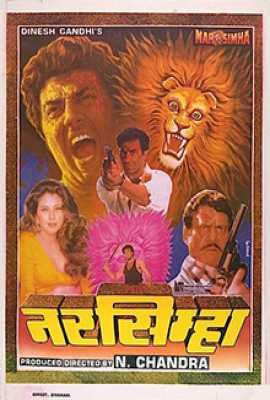
Narsimha (Narsingh) is a young, capable man living a quiet, middle-class life with his family. After arranging the marriage of his sister to an eligible young man nearby, he returns home for his sister's delivery. He finds his neighborhood engulfed in a communal conflict that quickly spreads across the entire city. Narsimha seeks refuge nearby, only to return and discover his entire family has been murdered.
Devoid of purpose, Narsimha descends into alcoholism and crime. He begins working for Suraj Narayan Singh, also known as Bapji, a cruel landlord and capitalist who controls the city's crime, law, and order through sheer wealth and muscle power. Bapji is delighted to have Narsimha, who possesses both wit and strength but lacks the will to live. This emotional detachment allows Narsimha to execute Bapji's most difficult, near-impossible tasks without question. Bapji, believing himself invincible and the city completely subjugated, sees Narsimha as the perfect weapon for his complex problems.
While Narsimha remains drunk and reports to Bapji only when summoned for assignments and payment, he has not completely lost his humanity, occasionally helping people in distress.
Bapji publicly declares his invincibility, boasting that due to his power and wealth, he cannot be killed by man or animal, day or night, or by any weapon or device. This echoes the boon received by the mythological King Hiranyakashyap. He demands the city's people consider him as their Lord and Master.
The conflict begins when Bapji discovers his daughter, Meenu, is in love with her college mate, Ravi. Bapji orders Narsimha to destroy Ravi's family and kill Ravi. However, witnessing the honest and revolutionary character of Ravi's sister, Anita, humanity rekindles in Narsimha. He vows to protect Anita's family, and he and Anita gradually fall in love.
Narsimha, now aided by Anita and Ravi, confronts Bapji, demanding he allow Meenu and Ravi to marry. Narsimha is the only one strong and smart enough to openly take on Bapji. With the help of his few loyal friends, Narsimha and Anita successfully rouse the local community against Bapji's oppressive and illegal rule.
Bapji employs every trick, using his goons and muscle men, but Narsimha thwarts his efforts repeatedly. Narsimha even humiliates Bapji by killing his famed wrestlers in Bapji's private court, showing the city that their tyrant was, for the first time, afraid. Pressure from the people, led by Narsimha and Anita, eventually forces the police to arrest Bapji for his illegal activities, though he soon uses his wealth to secure bail.
Released from jail, Bapji forcibly decides to marry Meenu and locks her away. He captures Narsimha and fatally stabs his abdomen with a sword. Bapji then reveals the ultimate truth: he planned the communal riot that killed Narsimha's family, using fear to keep the populace weak and submissive. He orders his men to bury the half-dead Narsimha inside a palace pillar and plaster it over.
The next morning, as Bapji attempts to forcibly wed Meenu, Anita and Ravi arrive with their friends to stop the wedding. Bapji releases prisoners from jail and arms them to control the crowd. When Meenu refuses the marriage and goes to Ravi, Bapji orders both of them to be plastered alive into his palace wall.
At that moment, the wounded Narsimha shatters the pillar he was entombed in, fulfilling his namesake—the fourth avatar of Lord Vishnu who burst from a pillar to kill the demon Hiranyakashyap. Narsimha takes on Bapji's goons, joined by his friends and the local people. He vanquishes the criminals, rescues Meenu and Ravi by breaking the wall, and the damage to the structure causes the palace's foundation and roof to crumble. Finally, Bapji is killed when the arms of the palace's tower clock break off and fall on him. Ravi and Meenu get together, and peace returns to the town.
The story ends on a happy note when Anita and Narsimha finally express their love for each other.